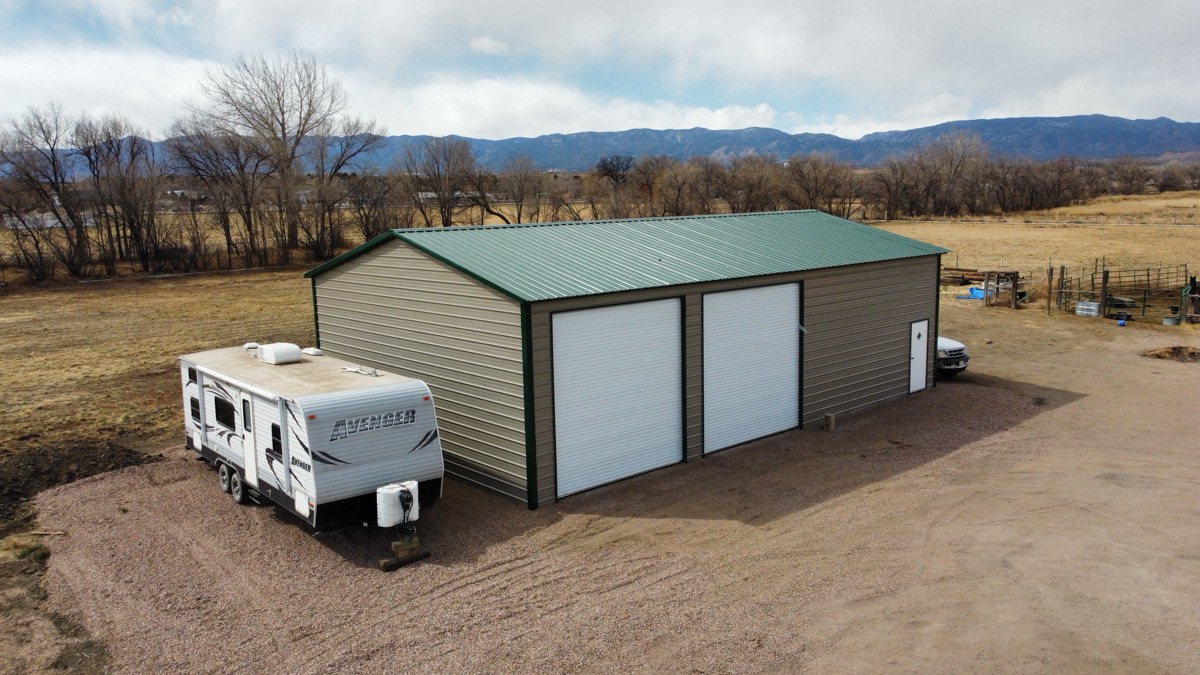

Written by Rocky Mountain Metal · Reviewed by Micah Hostetler, Owner · Based in Penrose, CO, serving Colorado.
Power comes from a subpanel fed by your house panel or from a separate utility meter. Water comes through a buried line below frost depth to a frost-free hydrant or interior plumbing. Trench both before the slab is poured.
Key takeaways
- Decide power and water routes before the pad and slab, and trench once.
- A subpanel fed from the house is simpler; a new service makes sense for big loads or long distances.
- Water lines go below your county's frost depth, and yard hydrants should be frost-free.
- Electrical and plumbing usually need their own permits and inspections.
- Stub conduit and sleeves under the slab now, even for things you'll add later.
Should I run a subpanel from the house or get a new service?
Subpanel fed from the house
A feeder runs from your main panel to a subpanel in the new building. It's the right answer for most garages, shops and barns a reasonable distance from the house, as long as your main service has room. Think about:
- Load. List what you'll run: welder, compressor, heater, lights, well pump, stock tank heaters. Size the feeder and subpanel with room to grow.
- Distance. Long runs need heavier wire to control voltage drop. Past a certain distance a separate service can cost less.
- Main panel capacity. An older, smaller house service may not have room, and upgrading it sometimes becomes part of the project.
Separate service and meter
The utility sets a new meter at the building. That suits large shops, buildings far from the house, ag operations that want separate metering, or a house panel that's already full. It involves a utility application and their schedule, so start early.
Either way, a licensed electrician sizes the system for your equipment list, and the work is permitted and inspected.
How do I get water to the building?
- Source. From the house supply, straight from the well, or a second well if the parcel and water rights allow. A domestic well's permitted uses can be specific, so check your well permit before tapping it for livestock or a second building.
- Depth. The line goes below frost depth, which is deeper at higher elevations. Your county building department can tell you the requirement.
- Hydrant. A frost-free yard hydrant drains below the frost line when shut off and is standard at barns. Interior plumbing in a steel building needs heat or freeze protection.
- Drainage. A floor drain, wash rack or bathroom needs a legal place to go, so septic capacity and health-department rules apply.
Can power and water share a trench?
Often, with the separations code requires. Plan the route from the meter or well to the building before the pad is built so the trench doesn't cross a finished drive or slab later.
What should go under the slab before it's poured?
A steel building's slab is poured to the engineered drawings before the manufacturer's crew arrives, so this is your one easy chance. Put in:
- Conduit sleeves to future locations: a lift, a compressor, a welder, a center bench
- Conduit to where an EV charger or generator might go
- A water stub for a future bathroom or utility sink
- Radiant tubing if there's any chance you'll heat the floor. See insulating and heating a shop
Sleeves are inexpensive before the pour and a saw-and-jackhammer job after.
Where should the panel and penetrations go in a steel building?
Decide where the subpanel, the service entrance and any water line come up before the order goes in. Panels mount best on a wall without a large door, and penetrations should come up through the slab inside the wall line rather than through the steel siding where you can avoid it. Tell your electrician where the frame members fall so boxes and conduit runs fit cleanly.
Who handles permits and the trades?
Building, electrical and plumbing permits are usually separate, and requirements vary by county. We'll walk you through what yours requires. Close to home in the Penrose and Fremont County area, Rocky Mountain Metal can coordinate site work as part of a start-to-finish project. Farther out, we supply and oversee the building, and you line up a local electrician and excavator; Micah will tell them what the building needs. See do I need a permit?
Plan it at the site visit
Where power and water come from is one of the first things we look at with you, because it can change the best spot for the building. It's part of the free quote, anywhere in our service area.
Frequently asked questions
How much power does a shop need?
It depends on the equipment. A light hobby shop needs far less than one with a welder, a large compressor and electric heat. List your equipment and have an electrician size the subpanel with room to grow.
Can I run the power myself?
Rules vary. Many jurisdictions require a licensed electrician for permitted work, and some allow homeowners to do their own with inspection. Ask your electrical authority before you start.
How deep does the water line need to be?
Below the local frost depth, which your county sets and which is deeper at elevation. A frost-free hydrant handles the above-ground part.
Can I use my domestic well for the barn?
It depends on the well permit's allowed uses. Check the permit or ask the state engineer's office before assuming.